The island people do not expect
Caprera is the archipelago's surprise. Many visitors cross it only to reach beaches; people who know the place come for trails, history, and the quality of air that changes as soon as you pass Ponte della Liberta. It is an island you cannot understand in one day and do not forget once you do.
It is not small: 16 square kilometres of granite, scrub, holm oak, and coastal paths connecting coves otherwise reachable only by sea. Compared with La Maddalena - lively, commercial, active - Caprera is quiet. You feel it already on the bridge.
Garibaldi Compendium
The Casa Bianca, where Giuseppe Garibaldi spent the last twenty years of his life, is one of Italy's most intact historic places. It is not a museum staged for tourism: it is a house. Kitchen, bedroom, the garden mill, the tomb in the holm-oak grove. Garibaldi chose Caprera in 1855 not for exile but by deliberate decision - a difficult island to reach, with land that required work. Private and public life stood here less than one hundred metres apart.
You reach the Compendium from Caprera's main road, following signs from Stagnali. Visit time is about one hour, best in the morning before buses arrive. It is not optional: one of the most honest entry points into Italian Risorgimento history, far from textbook rhetoric.
Stagnali and the Sailing Centre
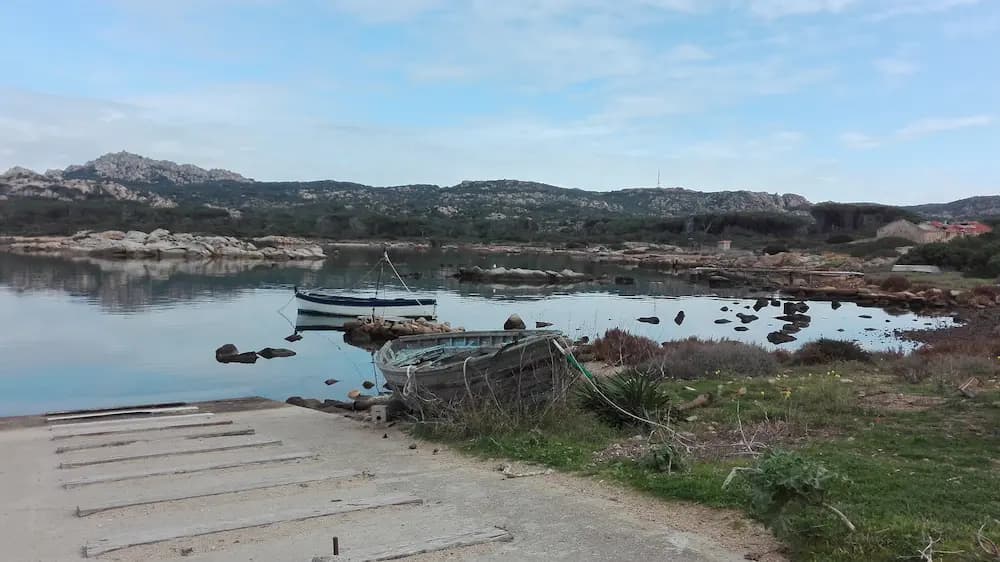
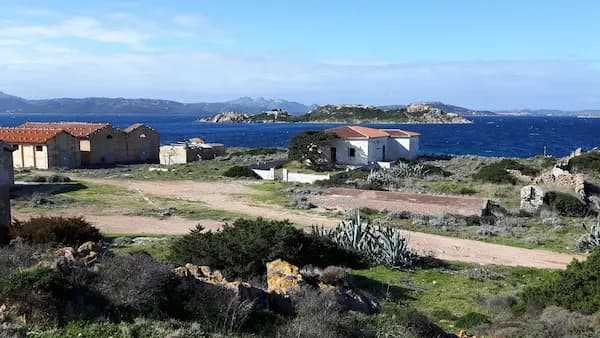
Stagnali is the small bay on Caprera's south-west side where Centro Velico Caprera has had its historic base since 1967. One of Italy's oldest sailing schools: here water is flat and sheltered, with regular breeze arriving after 10 a.m. It smells of salt and fresh paint, children learning to hoist sails, adults discovering there is no expiry date on learning to navigate. The Centre offers every level, from absolute beginner to advanced training. It is worth visiting even just to understand water behaviour in this specific point of the archipelago.
Trails: Punta Rossa and the Two Seas route
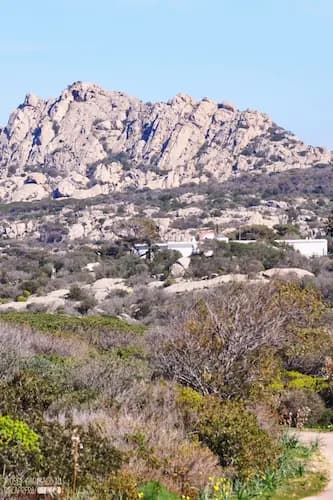
The route to Punta Rossa - Caprera's north-east tip - climbs through low cistus and mastic scrub along granite blocks shaped by wind over centuries, up to a red-striped lighthouse on a white spur. From here Corsica is close enough to distinguish reliefs: you are at the edge of the Italian archipelago, one step before the maritime border. Round trip takes about three hours with stops; accessible but not trivial, and not for August afternoons.
The Due Mari route divides the island lengthwise, with simultaneous views toward the Strait of Bonifacio side and the open-sea side toward Sardinia. Monte Fico, in the island centre, is the highest point: from here you read the whole landscape - all archipelago islands together, from Spargi to Razzoli.
The coves
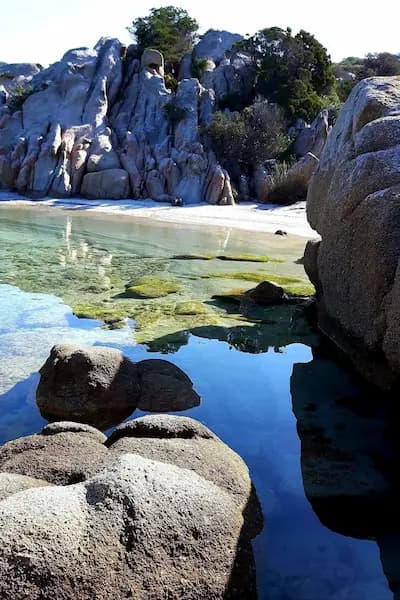
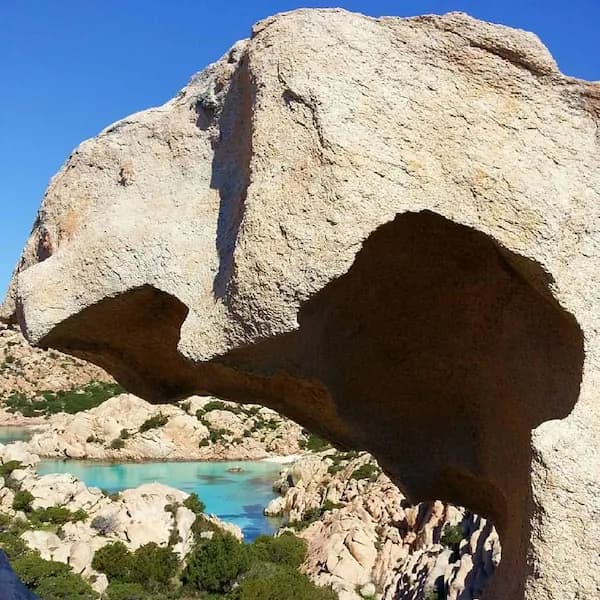
Cala Coticcio is the most famous, smallest, and most protected. Water quality is difficult to describe without sounding vague: clear to the bottom, green that turns blue within a few strokes. You reach it on foot from Caprera parking (45 minutes on marked trail) or by dinghy. At dawn you may have it to yourself. At 11 a.m. you share it with charters.
Cala Napoletana, on the north-west side, is wider and less postcard-like but more sheltered under Mistral. Cala Serena and Cala Brigantina are harder to reach by land and almost always empty out of season. Cala Garibaldi, near the Compendium, is the only beach reachable in flip-flops: flat bottom, fine sand, families with children.